
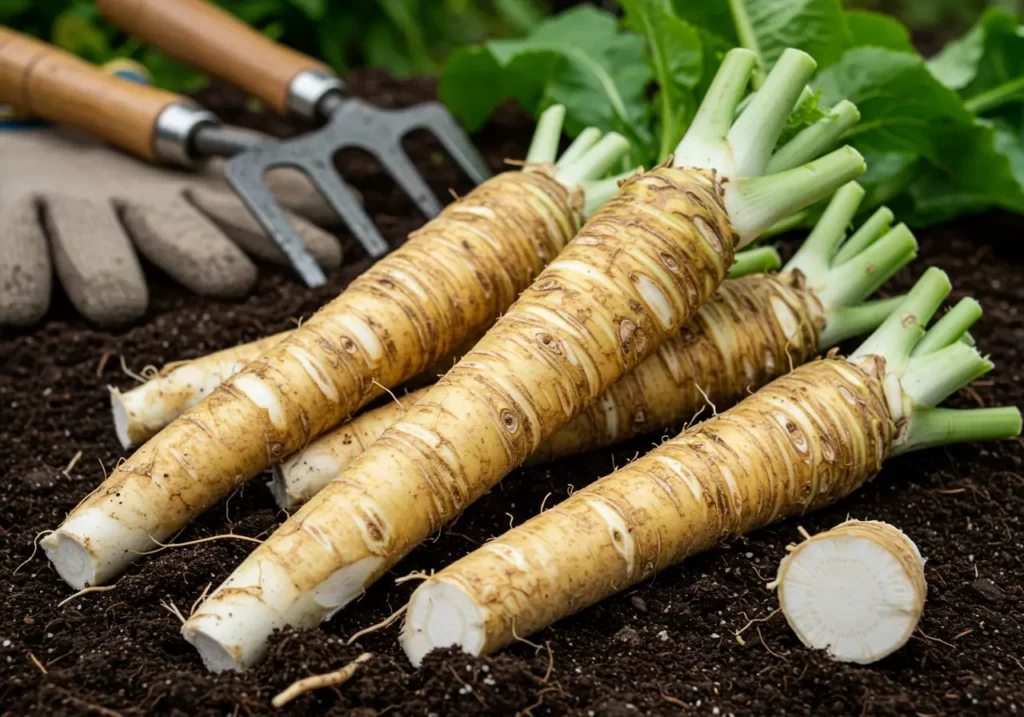
Horseradish A Powerful, Useful and Highly Invasive Plant you have to treat carefully.
Horseradish (Armoracia rusticana) is one of the strongest and most productive plants you can grow in containers. It provides excellent roots, large salad leaves, and has well‑known medicinal properties. But it is also famous for one more thing:
Even a thin root thread only 1 mm thick can grow into a full plant within months.
Because of this, controlled container cultivation is absolutely essential—especially in Spain.
🌿 Culinary and Medicinal Qualities
-
Culinary use: The sharp root is used in sauces, fish dishes, meat, and fermentation.
-
Salad: Young leaves are crisp, peppery, and excellent in salads.
-
Medicinal: Contains glucosinolates, vitamin C, and antibacterial compounds.
-
Regeneration: A survival superpower—any small root fragment can become a new plant.
🌋 Why Horseradish Should Never Be Planted Directly in the Ground in Spain
Horseradish has an extremely aggressive root system:
-
Roots spread horizontally in all directions.
-
Side shoots form constantly.
-
Every tiny root piece becomes a new plant.
-
In warm climates, growth speed doubles compared to Northern Europe.
In Spain this means:
One plant in the soil = 30–50 plants next year.
It can even push through gravel, weed‑fabric, and other containers.
🪴 Growing in Pots of Different Sizes – The Only Safe Method
Horseradish grows in stages, and each stage requires its own pot size:
-
Small pots (1–3 L): For root threads and small cuttings.
-
Medium pots (5–10 L): For young plants with expanding roots.
-
Large pots (15–30 L): For mature plants with heavy root production.
Advantages of pot cultivation:
-
full control over the root system
-
no invasion of the garden
-
easy relocation between shade and light
-
harvesting roots without damaging the main plant
💧 The Saucer – The Hidden Key to Success
This is a point almost nobody mentions, but it is critical in Spain.
The saucer has two essential functions:
-
Extra water supply — Horseradish must never dry out. The saucer acts as a small reservoir that keeps the soil moist even in dry wind.
-
Root‑stopper — When roots grow out through the drainage holes, they hit the saucer and cannot anchor themselves in soil or gravel.
-
They receive moisture.
-
But they cannot spread.
-
This stops the plant’s natural invasion completely.
-
It is a simple and brilliant method.
☀️ Spanish Climate – Why the Plant Can Die in Hours
Spain has a climate that is both perfect and deadly for horseradish.
Horseradish tolerates:
-
heat
-
high temperatures
-
dry air
Horseradish does not tolerate:
-
direct sun
-
drying soil
-
hot pots
-
dry wind
In full sun, even a large plant can:
die within 2–3 hours if the soil dries out.
Therefore horseradish must be kept:
-
in half‑shade or full shade
-
with constantly moist soil
-
in ceramic pots that do not overheat
-
with a saucer, and preferably double‑potting
💧 Watering Strategy for Spain
-
soil must stay moist at all times
-
keep water in the saucer during hot periods
-
deep watering 2–3 times per week
-
extra watering during windy days
-
never allow the soil to dry — the plant collapses instantly
⭐ Conclusion
Horseradish is a fantastic plant when grown correctly. In Spain, the keys to success are:
-
pots in varying sizes
-
a saucer as both water reservoir and root‑stopper
-
shade
-
constant moisture
With this method, the plant will live for years and produce both leaves and roots abundantly.
I'm selling fresh horseradish. Prices from €3.- to €10.- From Pinoso to Novelda, La Romana, Hondon and Aspe.
Please share this site with your friends. And if you think this is a good site, then send a couple of Euros to paypalme/Berdaljan


Add comment